NIGERIAN DISCOVERIES:
Nigerian scientist leads computer field with discoveries,
inventions
![[Philip Emeagwali]](../../gifs/Emeagwali_Sweater_June_1996.jpg)
+ p h i l i p e m e a g w a l i +
RELATED Discussions You said it ... This Man
RELATED |
By Amsterdam News
When a spectacular, year-long 50th year celebration heralds the 1946 invention of the first computer, a young man from Nigeria will be one of the principal honorees.
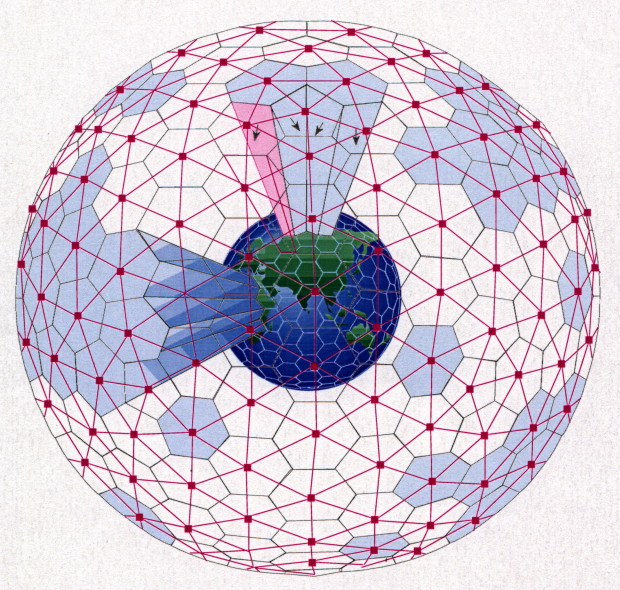
His name is Dr. Philip Emeagwali, and he discovered the hyperball
computer, which increased the speed of a massively parallel supercomputer to as much as
1,000 times faster than a mainframe computer and 1,000,000 times faster than a
personal computer.
Winner of fellowships and research grants, Emeagwali was also named 1996 Pioneer of the Year, as conferred by the National Society of Black Engineers during the March 30 convention held in Nashville. More than 6,000 scientists and engineers from around the world attended. Emeagwali, who has a Ph.D. in civil engineering and scientific computing earned at the University of Michigan at Ann Arbor in 1991, was born in Onitsha, Nigeria. He was tutored by his father, James, a nurse who loved math, thanks to one of his high school roomates, Chike Obi, who went on to receive a doctorate from Cambridge University in England. Until sixth grade, young Emeagwali was taught by his father, but the son surpassed the father. In junior high school, the son was considered a math genius and earned the nickname "Calculus," a subject he mastered at age 14 with the help of books from the library. At age 14 and upon completion of grade eight, he dropped out of school, as his father could not afford to send all of his nine children to school. Tuition in Nigeria must be paid for all education, from elementary to high school and beyond. Philip studied on his own and passed college entrance exams, accepting a scholarship to Oregon State University, where he received his bachelor's degree while working two jobs. His master's in civil engineering from George Washington University included designs for dams with a view to returning to Nigeria, where water supplies remain less than full in small towns. He earned two other master's degrees, in mathematics and in ocean, coastal and marine engineering, and then worked two years in Casper, Wyoming, as a civil engineer. At the University of Michigan he concentrated on his doctorate with the goal of increasing computer speed in order to determine how fluid --- water or oil --- flows underground.
But Emeagwali accomplished more than that. He developed the world's fastest computation
of 3.1 billion calculations per second in 1989, broke the world record for solving the
largest partial differential
equations with 8 million grid points in 1990, broke the world record for an unprecedented
parallel computer speedup of 2,048 in 1989, and in the
next year, 1990, broke the record for an unprecedented parallel computer speedup
of 65,536, and twenty other impressive "firsts" in his field.
An avid tennis player, he is married to a molecular biologist, and he
has sent seven of his brothers and sisters to college, brought his
mother from Nigeria to where they live in Washington, D.C., and he has
designed programs which teach youg children to use Internet, among other
computer skills. Today he is considered one of the most talented
computer scientists in the world.
Reported by Cathy Connors for New York Amsterdam News April 13, 1996. 
Click on emeagwali.com for more information.
|