
Frequently Asked Questions
Each year, half-a-million students use this Web site to prepare biographical reports and I have
received thousands of questions. Below are my previous responses to my frequently most asked
questions. To reduce the amount of repetition, I have not answered
questions that were previously answered in another interview.
Please note that since these questions were emailed to me from
1990 to present that my
opinions might have changed since I answered them.
 Student:
What do you feel is your greatest accomplishments?
Student:
What do you feel is your greatest accomplishments?
Emeagwali: In my personal life, my greatest accomplishment is being happily married since 1981, having a wonderful son and serving as a role model and source of inspiration to future generations of scientists.
In science and technology, my greatest accomplishment is my contributions to the development of faster computers and techniques for recovering more oil from petroleum reservoirs.
In industry, my greatest accomplishment is that I discovered a computing technique that will enable the petroleum industry to recover more oil and save about $400 million per oil field.
In society, my greatest accomplishment is that I have helped to destroy the stereotype that only whites are making contributions to cutting-edge science and technology.
Student: Can you describe your high school
experience?
After breakfast, we go to classes and studied subjects such as English, Literature, French, Latin, Geography, Arithmetic, Geometry, Algebra and Biology.
After school, we change from day uniform (white shirt, white short, and white sneakers) to our evening uniform (blue shirt, khaki short, and sandals).
After 15 months, ethnic conflicts led to the killing of 50,000 Igbos and like most Igbos, we fled to eastern Nigeria. As a result, I dropped out of school for three years of the ensuing civil and spent most of that time living in refugee camps.
At the end of the civil war, I enrolled in Christ the King College, Onitsha. There were no school buses and I had to walk for two hours (from Fegge quarters of Onitsha) to school. Four hours of daily walking mearnt that I was in good physical condition as a high school student.
Student: What were your favourite subjects in high school?
Student:
What is the most important thing you have ever done?
Philip Emeagwali (pronounced eh-may-ah-gwah-lee) is one of the first African Americans to produce a supercomputer. This computer can make 3.1 million calculations per second. This helps the oil industry by finding out how oil travels underground and to find this valueable black gold. He also helps schools in finding out how to overcome racism, prejudice and stereotypes. These were some of the problems he had to go through. He also won the Gordon Bell Prize in the United States. The Bell award is considered to be the Nobel Prize of computing. Check out his great web page at emeagwali.com. Mrs. Helene Aloi and Howard of Fowler High School in Syracuse, New York talks to him for the 1997 cyber fair.
Student: Do you have any religious
dances or songs that your parents left to
you?
Student: Who first taught you how to
use the computers? (How old were you then?)
My definition of computers is different from the widely held one. First, every human being is a computer. The word computer was coined 350 years ago and was used to described a person who computes. By the latter definition, I starting computing when I was a toddler.
As I got older, I started computing by using various computing aids such as (1) pencil and paper; (2) multiplication tables; (3) logarithm tables; (4) slide rules; (5) calculators; (6) electronic computers; and now (7) massively parallel supercomputers.
I was taught computing by pencil-and-paper and multiplication tables by my father. I taught myself how to use everthing from Table of Logarithms to supercomputers.
When I started working on massively parallel supercomputers, with thousands of processors, nobody in the world fully understood how to program them to solve practical problems. Therefore nobody could teach me how to program them. However, once I figured out how to program computers with thousands and millions of processors I was able to set numerous computing records.
Student: When you first started working
with computers did you like it?
Student:
What made you start on the
computer to make it faster?
The Connection Machine was sitting idle because no scientist could figure out how to program it. The laboratory chief was glad to find someone who is willing to use it and be a sort of guinea pig.
Student: Dr. Emeagwali: Do you consider
yourself as a role model for African
Americans and other ethnic groups in the world?
Student: Are you proud of what you
accomplished? And are you proud of your
profession?
Student: In Nigeria was there a lot of
racism?
Student:
Can you tell us how to stop
racism? (How to teach others to teach themselves?)
One way to stop racism is to properly educate white America on the heavy societal costs of racism. For example, more new prisons are being built each year than colleges. I have two concerns about this trend. First, prisons are built to last for decades or even centuries. This means that America has plans to continue its current practice of keeping one in three young black men in prisons, on probation or on parol for the next 100 years. In fact, if the United States continue building prisons, it might eventually lock up 2 in 3 black males behind bars. American prisons are the concentration camps and slave quarters of the 1990s.
My suggestion is for the United States to place a ban on the building of new prisons and to convert existing prisons to degree-granting colleges. Doing so will actually reduce crime and strengthen the economy. It costs $35,000 a year to keep a young black male imprison. In 1979, the United Nations Conference on Trade and Development estimated that each American professional between the age of 25 to 35 contributes $184,000 each year to the economy. If you add the $35,000 savings to $184,000 and adjust for nearly twenty years of inflation it is obvious that it costs over $250,000 a year to keep young black males imprisoned!!!
It is better to have our young men contributing $250,000 a year to our economy than spending $35,000 a year to keep them in concentration camps called prisons.
Student: Dr Emeagwali: How could you
succeed in life without an education to back
you up?
Student:
How did you feel when you
discovered you found the secrets for the fastest
computer?
Student:
Did you have to spend hours
finding out what was the solution to the
supercomputer?
Student:
Was the honeycomb shape that
bees make in their hive the main
solution to the supercomputer, or did you have to
change the design?
Student:
Do you have a message that you
would like to send?
My name is Lorenzo Crosby from Atlanta, Georgia I am a senior at North Springs High School. In my Composition class the students were ask to do research on a person whom has made a contribution to American society. Because I plan to major in Computer Science next year at Indiana Universiy and I'm a minority I chose you. To me you are the only African or African American who has contributed to American society the most in the field of Computer Science.1. PREPAREDNESS. Life is a journey of about 80 years. You spend the early years preparing for the latter part of that journey. To be the best in what you do --- sports, entertainment, science, etc, requires many years of training and preparation. I attended college for 15 years before gaining recognition as one of the best scientists in the world. As they say in Hollywood: "It takes 15 years to become an overnight success." You cannot be fully prepared for life by having a baby out of wedlock and dropping out of school.
2. PERSEVERANCE. The road to success is rocky and requires perseverance to overcome the various obstacles, such as poverty, physical, mental and emotional disability, divorce, sexual discrimination and racism. I grew up in poverty and was forced to drop out of school, lived in African war refugee camps and was homeless in Washington, D.C. However, I never gave up struggling and it paid off.
3. RESILIENCE. A resilient person never accepts defeat or failure. He or she keep trying. Heavyweight boxing champion "Smokin" Joe Frazier once gave this advice. When your nose is bleeding, fight one more round. When you head is aching, fight one more round. When your legs are wobbly, fight one more round. Always remember that he that fights one more round never loses.I spent several years pursuing countless scientific theories that turned out to be useless but I was resilient and viewed those failures as learning experiences that helped me become a better scientist.
4. INDEPENDENCE. You have to do things you strongly believed in. Makeda, the Queen of Sheba (modern Ethiopia), made the arduous journey across the desert and the Red Sea learn wisdom from King Solomon.As a teenager, family members opposed my coming to the United States to study because they felt I was too young to live in a strange country by myself. I disobeyed them, came to the United States and succeeded and today they are glad that I disobeyed them. As a scientist, other scientists call my ideas and line of enquiry foolish and tried to discourage me from pursuing them. Again, I disobeyed them, made important discoveries and today they are glad that I disobeyed them.
Great scientists are innovative and non-conformist thinkers who followed their hearts and ignored the conventional wisdoms. Leaders in other fields are individuals who are not discouraged by the rejection of their ideas.
5. TAKING RISKS. We have a natural tendency to avoid taking risks. Harriet Tubman, the "Moses" of the Underground Railroad, risked her life to rescue and bring freedom to over 300 African slaves. Galileo took a risk and was imprisoned for writing that the Earth is not the center of the universe. Christopher Columbus took a risk when he sailed into unknown waters to become the first European to discover America. The native Americans who came to America 30,000 years before Columbus took an even greater risk. As a scientist, I strive to think differently from other scientists which, in turn, has resulted in lots of failures and successes.
6. CONVICTION. Martin Luther King had absolute conviction that his fight for civil rights is worthy cause and therefore did not back down when he received several death threats.
7. FOCUS. While it is important to always remain well-rounded, focus on the primary objective is important for success. The two best known African-American scientists, Benjamin Banneker and George Washington Carver, were so focused in their work that they never found time to marry or have children. While such extreme single-mindedness and devotion is not recommended, unnecessary distractions such as being on drugs or becoming a teenage parent makes it very difficult to make important contributions to society.
8. HIGHER PURPOSE. Successful people are driven by a force or higher purpose to accomplish their goals. This higher purpose could be service to humanity (Mahatma Gandhi, Susan B. Anthony and Martin Luther King), service to God (Mother Theresa) or the search for beauty, truth and knowledge (Leonardo da Vinci, Alexander Graham Bell and Albert Einstein).
9. CURIOSITY. Many people were great not because they had a lot of formal education but because they were curious. Garrett Morgan that invented the traffic light and gas mask had 8th grade education. Thomas Edison dropped out of high school. Albert Einstein was such a poor student that his grade school teacher told his parents that he is retarded and his high school teacher convinced to drop out of high school. What Morgan, Edison and Einstein had in common is that each had a burning desire to invent things and solve the mysteries of the universe.
10. CREATIVITY. Successful people are willing to seek new solutions to old problems or accomplish a lot with limited resources. The African military genius, General Hannibal, had few soldiers and supplies and received sporadic and limited reinforcements. Yet, by being creative including using elephants to transport his soldiers across the Alpines, he was able to strike fear into the Roman army which outnumbered his. Today, warfare tactics innovated by Hannibal are taught in military schools.Creativity is not immutable and genetically encoded upon renown scientists or military generals. An individual can boost her creativity by remaining motivated, curious, openminded and imaginative.
We either have these characteristics or qualities within us or we can study and learn them. No person was born great. We become great by practing these ten qualities and using great people as our role models.
Lorenzo Crosby: Do you have any childhood
memories pertaining to computing?
Lorenzo Crosby: What led you to all the different
universities that you studied at?
Lorenzo Crosby:
Did you find it extremely
difficult to obtain five different degrees?
Lorenzo Crosby: Anything that you would like
for me know about you currently in
terms of your research, family life, or hobbies.
Ms. Emily Chapman is a high school student in Virgina with an interest in computer science.
Emily Chapman:
What do you feel is your
greatest accomplishments?
In science and technology, my greatest accomplishment is my contributions to the development of faster computers and techniques for recovering more oil from petroleum reservoirs.
In industry, my greatest accomplishment is that I discovered a computing technique that will enable the petroleum industry to recover more oil and save about $400 million per oil field.
In society, my greatest accomplishment is that I have helped to destroy the stereotype that only whites are making contributions to cutting-edge science and technology.
Emily Chapman:
Would you encourage young high
school students like me to continue
computer science on into college and into a career?
We are Amir Palm Bellamy and Devin Jefferson Baptiste, two physical science eighth grade students attending The Rice School in Houston, Texas. We have selected you to do research about for our science project.
In our eighth grade cluster, there are only four African American students out of 150 kids taking advanced math and science classes. We are two of them and have been inspired by your story of brilliance and determination.
We have reviewed information on the Internet about you and your family's accomplishments in the fields of math and science and would like very much to conduct a telephone interview with you.
Bellamy/Baptiste: What motivated you to become a computer
scientist?
Bellamy/Baptiste:
What was your primary driving
force to
be successful?
Overcoming these obstacles made me a much stronger person and my desire not to repeat the same mistakes is my driving force to be successful.
Bellamy/Baptiste:
How did Benjamin Banneker inspire
you?
Banneker inspired me because he overcame the unimaginable stress of being a black scientist in 18th century America to make positive contributions to society. Banneker spoke out against slavery.
Banneker inspired me because he self-taught himself mathematics and science at a time it was a crime in America to teach a black child how to read and write. Since blacks could not read or write, whites believed that blacks were intellectually inferior and therefore should be enslaved. For example, third president of the United States, Thomas Jefferson wrote in his book Notes on Virginia:Comparing them by their faculties of memory, reason, and imagination, it appears to me that in memory they are equal to the whites; in reason much inferior, as I think one could scarcely be found capable of tracing and comprehending the investigations of Euclid; and that in imagination they are dull, tasteless, and anomalous.
However, when Jefferson later read the works of Banneker, he changed his opinion that blacks lacked the intellectual capability to understand mathematics.
Banneker inspired me because he convinced Thomas Jefferson that "the color of the skin is in no way connected with the strength of the mind or intellectual powers."
Because Banneker was a black scientist with extraordinary courage and curiosity, he is my role model and source of inspiration.
Bellamy/Baptiste:
What made you decide to
start the program with the supercomputer?
However, my working with the Connection Machine, a massively parallel supercomputer, was by a type of accident called scientific serendipity. I originally applied to work with Cray supercomputers which cost $30 million each. The Cray account was issued to me by email but then revoked when I went to get the password in person. Since white individuals who applied for the Cray account were automatically given the accounts while I was denied it after several attempts, I realized that I was being discriminated against because the white supercomputer manager was prejudiced and believed that a black scientist lacks the intellectual ability to program supercomputers. As a result, I switched my interest to the less expensive Connection Machine supercomputer which, at that time, was believed to be an inferior supercomputer. My accomplishment was that I subsequently demonstrated that the Connection Machine's massively parallel technology is much faster than the Cray's vector technology.
Bellamy/Baptiste:
How long did it take you to make the Connection
Machine?
To successfully program the Connection Machine to perform the world's fastest computation of 3.1 billion calculations per second required all the mathematical, engineering and computer skills that I have acquired from kindergarten to completing the equivalent of five graduate degrees in five different fields (at the age of 35). In that sense, it took me a lifetime. As they say in Hollywood, it takes fifteen years to become an overnight success.
Bellamy/Baptiste:
Is the Connection Machine being used by
any major oil company?
Bellamy/Baptiste:
What did it mean to you to win the Gordon
Bell Prize?
Bellamy/Baptiste:
How many other scientists were trying to
solve the same problem and what success did they have?
Bellamy/Baptiste:
Who was your favorite scientist when you
were growing up?
Bellamy/Baptiste:
Please elaborate about you
views on intolerance?
Bellamy/Baptiste:
What did your colleagues
think of your
discovery?
Bellamy/Baptiste:
What is the Africa One Project
and what
will its role be in accessing other African countries to the
Internet?
Turner:
I'm interested in learning more about Fillunger's
equations, and how they relate to your research in parallel computing for
the oil industry.
However, in my research, I proved that Fillunger's equations were indeed correct and I used them in my 1989 Gordon Bell Prize winning computation.
Turner:
I would also like to know the technical name for
the software you developed petroleum industry, and which companies use
it.
Turner:
I found everything I needed except what Fillunger's
equation was. It doesn't seem to be in the Encyclopedia and I can't find
it elsewhere.
White House Fellowships Office:
What are your lifetime goals?
As a teenager, I set the goal of becoming a mathematician and ended up becoming a well-known scientist whom young people consider to be their role model. I receive nine e-mail a day from young people in the United States, Europe and Africa. Since half of the world's population is under the age 20, I will be making an important contribution to society by working with K-12 schools and encouraging students to stay in school and possibly become scientists.
At a personal level, I want peace of mind, good health and a close relationship with my family and friends. I have learned that money cannot buy me happiness. It just pays my bills. I am not interested in buying a new vehicle or a new home or an entertainment gear. Buying things give me short term good feeling, but in the long run the enthusiasm wears off.
Again, life is a journey and my goal is to enjoy mine while making scientific discoveries that will benefit mankind.
D. Murray (7/10/00):
I certainly admire your brilliance and humility, and I wish you continued success.
Why is it that your achievements have been so downplayed by corporate America?
The very part of America that is now benefitting from your innovations.
D. Murray's Response: 'Tis still true today. I actually got a job without a face-to-face interview. Also, as an experiment, I had a white friend of mine, who I actually tutor, apply for a job with my resume and he got it even though in the interview he was not able to answer most or all of the questions put to him. I applied for the job using a sort of fabricated resume and went in for an interview and answered everything and they told me they will call me and they never did. hmmmmm
Emeagwali:
In my 27 years of working in the United States, all my white supervisors and potential collaborators had less qualifications than I did. Since my white colleagues were unable to pull their own weight, I have never been able to successfully complete a research project with a white scientist as my collaborator.
Deryck Murray (7/10/00):
I have for a lesser part or greater depending on how you look at it, have been
subjected to such discrimination. I am, myself an aspiring programmer and/or info tech
professional. I have noticed that when I do interviews over the phone, they are usually impressed
with my knowledge; but when they meet me in person and see that it's a black man, they seem to
be pleasantly surprised and somewhat apprehensive about hiring me.
WEBMASTER'S NOTE: The answers to the questions below will be posted at a later date.
Student:
Can you tell me some of the memorable things that occured in your high school?
Student:
What were the most remarkable things that happened to you?
Student:
What were the most despicable things that happened to you?
Student:
What were the most admirable things that happened to you?
Student:
What human qualities were responsible for shaping your life?
Student:
What human qualities were responsible for shaping your work?
Student:
What are some of the worst bad decisions and mistakes you made in your life?
Student:
Which of your qualities/traits proved most difficult and troubling?
Student:
What are the most important lessons you learned from your mistakes?
Student:
What are the most important lessons a young person can learn from your life?
Student:
Which of your qualities/traits proved most beneficial in your life and work?
Student:
Who are your mentors and what guidance and encouragement did you receive from them?
Student:
What role did religion play in your life?
Student:
Which political events in Nigeria and other countries affected your life?
Student:
What would you like to be remembered for?
Student:
What should you be remembered for?
Student:
What were the most memorable things that occured to you in the Biafran war?
Student:
In what ways has Nigeria and Africa changed in your life time?
Student:
When given an opportunity to reflect on your life what would you say?
Student:
How did events in your life affect you psychologically?
Student:
What is your psychological makeup?
Student:
What made you the way you are?
Question:
Hi my name is [name withheld] I am a African American Male who is
struggling with my self esteem
Unfortuninatly I agree with allot of White Racist in America on subjects
such as they say that
a Rocket Ship will never blast off from Black Africa,nothing high tech
comes from black Africa,
I've been doing a test over the last year or so I work in Television and
see allot of high
tech equipment and nothing comes from black africa. It saddens me to see
so many African Americans
putting all there effort into basketball. Sir what i need from you is to
prove me wrong. Could you
tell me what high tech Black Africa exports to the world.
By the way, one-third of African scientists are working in Europe and North America which, in turn, means that Africa is exporting one third of her technological knowledge.
E.O. [name withheld]:
phillip emeagwali
your accomplishment speaks well of how you have applied yourself in america and blessing from GOD.
now, how has this helped your native village? what are the tangible collateral value of your accomplishment to uplifting or transforming the stagnant economic situation in onitsha and or anambra? i think the rest of us would be highly encouraged and applaud, when and if nigerians can start turning their so called brain power into ownership of corporations and creating employments for its people.
all these shows of acamedic accomplishments without dimensional success in economic, business and corporate development is not impressive to me. nigerians started showing up in US in 1918; zik in 1924 but with more than 80 years of presence, we are just present but not quantifiable.
in one of your speehes you indicated that nigerians is the highest educated ethnic group in US, i doubt that but i will subscribe to it for the sake of going along. but with that percentage how come we are low in the following:
no ownership of credit union
no credit access
no neighborhood in america will/can credit us for its development
no education fund
no legal defense fund
no or minimal support for health issues that affect us, and so forth. these are the areas immigrants are measured and judged in US and with the claim of having the highest education among ethnic groups, i wonder what is missing in our education? did we just go to school but school hardly did not go through us? most nigerians that teach at colleges are not tenured. and many in corporate establishments are line managers. please help me understand.
we must stop pandering to our people because the performance outcome compared to our education is a 'shame'. most of us are disappointments to our parents that spent their last 'kobo' to see that we get education. at the end we blame everyone but ourselves for what we did not or could not do.
onitsha probably has the highest concentration of educated persons per town in the old east. but it is as desolate and disfunctional as most villages without the same amount of educated folks/fools. please show me what you have done to turn things around in onitsha before you take your show on the road. charity should start at home. you cannot hold brief for igboland and nigeria while your immmediate home is on fire. or is this a case of 'no prophet is recognized in his home town'? tell me the reasons and no excuses!
your accomplishments speaks well of your talent and individual fortunes but an average igbo/nigerian cannot relate his doing here and at home to what phillip emeagwali has done. you may [not] be the lighting rod or beacon because no tangible transformation can be traced to folks like you. please educate me otherwise.
other immigrants with marginal education come to US and corner a piece of america but for nigerians, we fool ourselves with degrees and attribute our low performance to what is going on at home - excuse. we are disfunctionally educated.
in the meantime, enjoy your accomplishments. folks in my village are not cheering because phillip emeagwali is not leaving food on their table. i cheer men who create jobs and help their people transform and not those that parade degrees and give speeches. i like to dance to the beat of economic emancipation than educational acomplishments that leave our people more confused than they were going in. PHD - permanent head damages.
there is no nigerian owned company in US that has 10-20 nigerians employed. you an find every immigrant group providing employment for its people but for us, we are all occupying desks at some other establishments and with bogus claims of what we have accomplished. please show me the MONEY and economic development initiatives attributable to the zillion years we have acquired in formal education?
more success for you but until an average onitsha man can get employment at onitsha and attribute that to his SON, your showing is just for the PAPERS.
TIME magazine voted Albert Einstein as the "Person of the Century." Although Einstein's "Theory of Relativity" has no economic or political value, the Jews did not criticize him for not helping them resolve the long-standing Middle East crisis. He was offered the presidency of Israel but he declined.
Do you think sending a man to the moon helped reduced inner city poverty? But Americans have not abandoned space exploration and the first man to walk on the moon is considered an American hero.
Are you not proud to see Ben Enwonwu's sculpture displayed at the United Nations' headquarters? Why is it important for Dick Tiger to become a world boxing champion? Weren't you inspired when Chioma Ajunwa or Kano Nwankwo won Olympic gold medal?
There is more to life than just eat, eat and eat. Chioma Ajunwa has inspired more Nigerians than any Onitsha trader or farmer. As you can tell from http//emeagwali.com/Guestbook/guestbook.html, my work inspires young Nigerians to work harder and contribute more to the world.
The caucasian race pursued knowledge for the sake of knowledge and to help humanity while Ndi-Igbo insists on pursuing knowledge for the sake of personal wealth. The primary goal of my technological contribution is to help humanity which, in turn, will help Ndi-Igbo.
Knowledge, especially technological knowledge, creates wealth. Therefore, we must seek knowledge before wealth. Ndi-Igbo are seeking wealth before knowledge and the result is that the Igbos has neither. As you know, it is not mere coincidence that the educational gap between northern and southern Nigeria has resulted in economic gap between both regions.
The computer and the Internet that you use to send your daily email is the by-product of a succession of inventions and discoveries by many scientists, including myself. Without people like me, you will not be able to send email to Nigeria. Although we (scientists) have not put bread and butter on your breakfast table, our intellectual creations have made life easier for you, and eventually Ndi-Igbo.
You have raised many issues and I apologize for not having the time to provide more in-depth response. On a personal note, people in my hometown of Onitsha can tell you that I have brought 22 people to the United States. An 80-year-old Igbo man observed: "If one million Nigerians abroad [or one percent of Nigerians] were to sponsor 22 students [or 22 million total] to study abroad or were to make the technological contributions that Emeagwali did, Nigeria will become a developed nation."
:
Mauvaise nouvelle pour les
racistes, eh eh !De : @ (Visiteur)
Courrier électronique : @
Date : Sam 05 Aoû 01:41 MET DST 2000
Vous vous souvenez sans nul doute du savant génial de "Terminator
2" qui était, on s'en souvient, un afro-américain. À cette époque
avait fleuri la question :

"Ce choix est-il dû à un souci d'être politiquement correct, ou
le réalisateur avait-il en tête un savant particulier (comme par
exemple l'étonnant Docteur Bell avait inspiré à Conan Doyle le
personnage de Sherlock Holmes) ?"

Il semble que la seconde hypothèse ait été la bonne : bien qu'on
ne l'ait pas crié sur les toits, le concepteur de l'ordinateur le
plus rapide du monde, la Connection Machine, est un natif du
Nigeria, et semble-t-il pas du tout mécontent de l'être. Il
s'agit du docteur Emeagwali, dont voici la page :

http://emeagwali.com/

(Cette page n'est pas un ego trip de la part de son auteur.
Recoupement fait avec d'autres sites concernant l'histoire de
l'informatique, son apport à cette jeune science est
internationalement reconnu, et sanctionné par le rarissime prix
Bell).

Bienvenue donc au Nigeria dans le cercle des pays ayant apporté
leur pierre aux progrès de l'humanité. En espérant que cette
première gloire internationale ne sera pas la dernière venant de
ce continent :-)

"Un jour viendra où l'histoire qui sera enseignée aux écoliers ne
sera pas la petite histoire des rois et de leurs batailles, mais
la grande histoire des génies - artistes et hommes de science -
qui auront tous ensemble, sans se connaître, oeuvré au progrès de
toute l'humanité".   (Victor Hugo, Journal)


Doctor,


In fact, I just signalled the existence of your Web site
in the Internet forum of "Le Monde", open to all of its readers,
at the folowing URL :


http://forums.grolier.fr:8001/lemonde/nonmembers/index.cgi?
do=showmsg&conf=Le_Mo.Le_Ko&msg=18122&show=unread&depth=all


(I am afraid the address will be folded by Netscape, so you
 will perhaps need some cut and paste to access the page)


I shall now try to translate my message in english (please
excuse me for any clumsiness in the translation as English
is not my mothertongue)


> >message: Docteur,
> >
> >Je suis enchanté d'apprendre que grâce à votre travail et à votre talent
> >le continent Africain fait une entrée fracassante dans le domaine des pays
> >contribuant à la marche en avant de l'humanité.


Doctor,


I am delighted to learn than thanks to your work and talent,
a new african country  makes a remarked introduction in the
circle of contributors to the progresses of mankind.


> >Je me suis permis d'en parler en rubrique "International" du journal "Le
> >Monde" (tout.lemonde.fr). Voici le texte qui a été déposé, sous le titre
> >(un peu provocateur, j'en conviens) de "Sale coup pour les racistes" :-)
> >Bien entendu, si vos activités vous en laissent le loisir, n'hésitez pas à
> >rectifier les erreurs que j'aurais pu commettre à ce sujet (selon les
> >sites web, certains vous disent Nigérian et d'autres Camerounais; je me
> >suis aligné sur ce que mentionne votre home page).


I took the liberty to touch a word of it in the "International" section of
the Internet forum opened by "Le Monde" newspaper. Here is the
text, that I posted under the title (somehow provocative, I have to admit
it) "Bad news for the racists" :-)


Of course, if your scientific activities still leave you some free time, please
feel free to correct any error I could have made (some web sites mention
you as a Nigerian, but some as a Camerounese; I just took what was
mentioned on your home page as the truth about that matter).


> >François-Dominique Armingaud
> >Paris, France
> >
> >Texte posté dans le forum :


Here is the text I posted :


> >Vous vous souvenez sans nul doute du savant génial de "Terminator 2" qui
> >était, on s'en souvient, un afro-américain. À cette époque avait fleuri la
> >question :
> >
> >"Ce choix est-il dû à un souci d'être politiquement correct, ou le
> >réalisateur avait-il en tête un savant particulier (comme par exemple
> >l'étonnant Docteur Bell avait inspiré à Conan Doyle le personnage de
> >Sherlock Holmes) ?"


You probably remember the genius computer scientist in "Terminator 2" who
was afro-american. At the time, a lot of people were wondering if the movie
director just wanted to be "politically correct", of if some real computer
scientist
had inspired him just like the astonishing doctor Bell had inspired the
character
of Sherlock Holmes to Conan Doyle.


> >Il semble que la seconde hypothèse ait été la bonne : bien qu'on ne l'ait
> >pas crié sur les toits, le concepteur de l'ordinateur le plus rapide du
> >monde, la Connection Machine, est un natif du Nigeria, et semble-t-il pas
> >du tout mécontent de l'être. Il s'agit du docteur Emeagwali, dont voici la
> >page web :
> >
> >http://emeagwali.com/


The seconde hypothesis seems to be the good one : though nobody
signalled it very loudly at the time, the designer of the fastest computer
on earth, the Connection machine, was born in Nigeria and seems quite
glad about it. He is doctor Emeagwali, whose web site is :


http://emeagwali.com/


> >(Cette page n'est pas un ego trip de la part de son auteur. Recoupement
> >fait avec d'autres sites concernant l'histoire de l'informatique, son
> >apport à cette jeune science est internationalement reconnu, et sanctionné
> >par le rarissime prix Bell).


This home page is by no way some kind of "ego trip". I checked the information
with other sites dedicated to computer science history, and the contribution of
Dr Emeagwali to this young science is internationally recognized, and got him
the notorious Bell prize.


> >Bienvenue donc au Nigeria dans le cercle des pays ayant apporté leur
> >pierre aux progrès de l'humanité. En espérant que cette première gloire
> >internationale ne sera pas la dernière venant de ce continent :-)


Welcome to Nigeria among the countries having brought their contribution
to the scientific progress of mankind. We can expect that this first
international
glory will not be the last one coming from the african continent :-)


> >"Un jour viendra où l'histoire qui sera enseignée aux écoliers ne sera pas
> >la petite histoire des rois et de leurs batailles, mais la grande histoire
> >des génies - artistes et hommes de science - qui auront tous ensemble,
> >sans se connaître, oeuvré au progrès de toute l'humanité".   (Victor Hugo,
> >Journal)


"Some day, children will be taught in school not the small history of kings
and wars, but the great history of geniuses - artists and men of science -
who all together, without knowing one another personally, will have
contributed to the progress of all mankind"


Victor Hugo (Journal)
Réf : Mauvaise nouvelle pour les racistes
De : juste (Visiteur)
Courrier électronique : juste@hotmail.com
Date : Sam 05 Aoû 02:29 MET DST 2000
Il n'y a que des individus intelligents.
Dire qu'un peuple est intelligent, c'est deja exprimer un
racisme latent.
Je suis ravi chaque fois qu'une minorite ethnique realise un
exploit intellectuel.
Merci pour la nouvelle. Meme si je n'ai pas le temps d'aller a
ton lien.
Le jour on enterrera les morts de confession differentes dans le
meme cimetiere, l'humanite aura franchi un pas dans la bonne
direction.
Réf : Mauvaise nouvelle pour les racistes
De : @ (Visiteur)
Courrier électronique : @
Date : Sam 05 Aoû 03:31 MET DST 2000
juste (Visiteur) écrivait :

: Je suis ravi chaque fois qu'une minorite ethnique realise un
: exploit intellectuel.

Moi aussi, mais peut-être pas pour la même raison :-) L'aspect
d'"égalité" de la chose ne me laisse bien sûr pas indifférent,
mais c'est surtout l'aspect d'efficacité qui m'intéresse. Il me
semble en effet que la variété des points de vues apportés par
différentes cultures est nécessairement un plus, puisque de cette
varité d'idées on ne retiendra en fin de compte que ce qui aura
marché le mieux.

: Merci pour la nouvelle. Meme si je n'ai pas le temps d'aller a
: ton lien.

Ce docteur Emeagwali est un personnage à suivre : d'une part, il
semble très désireux de faire tout ce qu'il pourra pour aider le
Nigeria à décoller. d'autre part, il le dit dans sa courte
biographie, c'est l'éducation qui lui a été donnée par son père
qui l'a aidé à devenir ce qu'il est (comme pour Mozart, comme
pour Pascal, et comme pour Léonard de Vinci, sauf que dans le cas
de ce dernier c'était un père adoptif) : on peut donc supposer
qu'il va utiliser les mêmes techniques pédagogiques avec ses
enfants, comme avec les étudiants qu'il aura certainement à
l'université s'il ne les a pas déjà. Je suppose qu'une belle
carrière politique l'attend dans son pays, si du moins il n'y a
pas là bas comme ici des coteries politiques mettant des bâtons
dans les roues à tout type valable au motif que c'est un
concurrent dangereux dont il faut se débarrasser.

: Le jour on enterrera les morts de confession differentes dans
le
: meme cimetiere, l'humanite aura franchi un pas dans la bonne
: direction.

S'il n'y avait que les histoires de confessions ! La plaque
commémorative aux morts de l'Ecole des Mines de Paris est agencée
de cette façon (à peu près) :

AUX ELEVES DE L'ECOLE DES
MINES DE PARIS MORTS POUR LA FRANCE

et, en-dessous, deux subdivisions :

ELEVES-INGENIEURS [les corpsards X-Mines]

puis, bien séparés :

INGENIEURS CIVILS [les autres]

Ils n'ont tout de même pas poussé le mauvais goût jusqu'à écrire
le nom des corpsards avec des lettres PLUS GROSSES :-)
Réf : Mauvaise nouvelle pour les racistes
De : lafricain (Visiteur)
Courrier électronique : @frique
Date : Sam 05 Aoû 07:33 MET DST 2000
@ (Visiteur) écrivait :
: Ce docteur Emeagwali est un personnage à suivre : d'une part,
il
: semble très désireux de faire tout ce qu'il pourra pour aider
le
: Nigeria à décoller.

Ce n'est pas le premier Grand nigérian. Il y avait déja Wole
Soyinka, prix Nobel de littérature dans les années 80: le premier
africain dans ce cas !

Je suppose qu'une belle
: carrière politique l'attend dans son pays, si du moins il n'y a
: pas là bas comme ici des coteries politiques mettant des bâtons
: dans les roues à tout type valable au motif que c'est un
: concurrent dangereux dont il faut se débarrasser.>>

Soyinka justement a essayé, mais il a fait de la prison et a du
ensuite vivre en exil pendant des années de dictature
militaire. Je ne sais pas où il en est aujourd'hui.
Réf : Mauvaise nouvelle pour les racistes
De : @ (Visiteur)
Courrier électronique : @
Date : Sam 05 Aoû 15:03 MET DST 2000
lafricain (Visiteur) écrivait :

: Ce n'est pas le premier Grand nigérian. Il y avait déja Wole
: Soyinka, prix Nobel de littérature dans les années 80: premier
: africain dans ce cas !

Argn! Quand je pense au nombre de prix Nobel de littérature que
je n'ai pas encore lus, j'ai honte...

Existe-t-il également une génération scientifique montante dans
d'autres pays africains comme le Cameroun, la Côte-d'Ivoire (il
parait qu'il y a un centre informatique fabuleux à Yamassoukro),
le Sénégal ou le Mali ? J'entends de gens qui, comme le génie
précité, ne se contentent pas de faire fortune aux USA ou
ailleurs pour s'y établir, mais viennent ensuite avec dévouement
"renvoyer l'ascenseur" en effectuant une mission d'enseignement
le reste de leurs jours dans leur pays d'origine ?
Friends of Emeagwali:
What is the purpose of "Friends of Emeagwali?"
Friends of Emeagwali will help students who did their school reports on Philip Emeagwali understand his current projects. It is a way for these students to utilize their enthusiasm about their interest in Emeagwali.
FAQ:
What can I expect to receive when I join "Friends of Emeagwali?"
You will receive a free and autographed electronic photo of Philip Emeagwali that you may later download and print. As an option, the president of "Friends of Emeagwali" will tell you where to purchase an incentive item such as a biography or t-shirt or poster. The materials may change from time to time and the annual newsletter and Web site will keep you updated.
When Emeagwali is visiting your city, Friends might have a "Friends of Emeagwali" luncheon or party. We tentatively plan to have "Friends of Emeagwali" gathering in Washington, D.C, New York, Paris, Berlin, London, Lagos and Abuja.
Question:
What should I not expect from "Friends of Emeagwali?"
Your primary reason for joining "Friends of Emeagwali" is to get current information and communicate with fellow fans.
Question:
How many Friends of Emeagwali are there?
Our projection is that at one in a thousand visitors might be interested in joining Friends of Emeagwali which, in turn, will translate to membership of several thousands over the years.
Question:
Will Friends of Emeagwali make money for Emeagwali or the organizers?
Question:
Why do I need to send a self-addressed stamped envelope?
Subject: The Nigeria of a Child's Dreams.
Date: Wed, 16 Aug 2000 06:36:55 -0700

Dear Phillip,
Or do I have permission to call you Chukwurah?

A very good day to you Sir. I have been in touch with
Chris after I read some of his articles in the Guardian
newspaper. I think that the fact that we need to develop
 our technology is something that we have  all known for
 a long time. The questions to be answered, in my view, are:
1. Why have we been unable to do this before now?
2. What are the obstacles to achieving this objective?
3. What is/are the surest(and shortest possible) means of
achieving our objective?

You see, I have lived in Nigeria my whole life and I have been
pondering these questions since my university days. Here are a
few of my views.
As a starter, the level of poverty in Nigeria is excrutiating.
The nigerian life is crowded and poor and life has become a
theatre. The worst part is that it is full of mediocre artists
and depraved directors. Even the so-called rich of our society
exhibit what I describe as "Genetic Poverty".This is the main
reason why they get into public office to steal and loot.
They will even steal from their children if they have the
opportunity. We therefore need to re-engineer every nigerian first.
Now, I believe the greatest obstacles to changing Nigeria is
our fear of change. For the young generation, it is easier to
make them see why we need to redirect. Where the mountain of a
problem lies is with the old school. Most, if not all of them
are "spoilt". They have been used to getting everything free
- education, housing and even food- hence they cannot task
their minds and brain.

If we are to get going technologically, we need a turbo charged
take-off. We are lucky that we have proven scientists and
professionals(like you) spread across the globe but they
will not return to Nigeria. I do not blame them! I almost
left this country myself a year ago but at the last moment,
I changed my mind. I wanted to leave because I wanted to
have quality post-graduate education. As a scientist I
know that until the right atmosphere is here there cannot
 be quality education in Nigeria. This is where the
 nigerian scientists who have had good education and
who can afford it can make a difference. Why for example
 is it that in Nigeria today I can get top quality
post-graduate education in the social-sciences( Biz admin
& marketing for example) but will not get same in the sciences?
 I tell you it is because some "whiz-kids" have returned home
to set up world-standard school(Lagos Business School &
ESUT Business school for example).

This I believe is the shortest and surest way of getting us
off on a good footing. The government is deep in the woods.
Everyday there are reversals of policies and their replacement
 with even more confused ones. All of them in power are Chiefs
 and title holders who don't know which side of the coin to
choose. They have malnourished visions of how to get this nation going.

One last point to note here is that we are over endowed in
this country human and material wise. I can tell you without
fear of contradiction that the opportunities in this country
are enormous. What we need is a private sector led technological
 drive. There are thousands of young graduates who have great
 ideas and who are ready to work hard and face the pains of
developing themselves. In America for example, internet access
is taken for granted but in Nigeria it is an exclusive priviledge.
 What can we do without information or must we all travel out of
these shores? The answer is an emphatic No!

You remain the most popular Nigerian whose voice will easily
hop across the atlantic to the ears of President Obasanjo and
the old brigade he has sorrounded himself with.

Please tell him that there should be a drive to encourage
quality education; to support graduates to set up SME's( and
not work 10-12hrs a day for a foriegn company that will one
day depart with it's technology). Also, talk to some Nigerians
who can come and set up quality science colleges and schools of
technology where dedicated scientific projects can be taken up
by the students.

This way we can have a Nigeria that is not weighed down by
poverty; where chieftancy titles will take the background and
hard work and intellect the forefront; where we are not scared
to make mistakes but are ready to learn from those mistakes;
where we shall effectively utilise our resources; where we can
recycle our domestic waste and not use it as a second coating
for the highway; where the unborn child has a right to life.
This is the Nigeria of a Childs Dreams.

Remain Blessed.
***Azuka Ijekeye(Lagos, Nigeria).


THE ANSWERS TO THE FOLLOWING INTERVIEW
QUESTIONS WILL NOT BE POSTED HERE UNTIL WE
RECEIVE THE SENDER'S PERMISSION


1. Date of birth and place of birth

2. Name of parents (indicate whether they are living or deceased).

3. Elementary school/s and secondary schools attended.

4. What were your most fund memories growing up as a child where you grew up?

5. How the Nigeria/Biafra war affect you?

6. How many siblings do you have? Where are you in the sequence of births?

7. Full name of your wife, where you met her, and where the
wedding ceremony took place.

8. Full name/s of your child/children where applicable, and
where they were born.

9. First year you arrived in the US and the purpose of your
initial arrival?

10. Your perceptions of the US prior to arriva?

11. Your impressions upon arrival fopr the first time? How was
it different from your prior perceptions before arrival?. What
are your impressions of the US now.

12. Who is/are your favorite American/s (living or dead) and why?
Who are your heroes (American or non-American) and why?

13. What would you say was the most glorious day of your sojourn
in the US, and why?

14. What principle/s would you not compromise on?


THE ANSWERS TO THE FOLLOWING INTERVIEW
QUESTIONS WILL NOT BE POSTED HERE UNTIL WE
RECEIVE THE SENDER'S PERMISSION


- Let’s say you’re addressing an audience of 300 african students
and professionals who live in Europe. Most of them have never heard
of parallel computers or the counter-intuitive hypercube paradox.
What can they learn from your achievements and inventions ?
- School dropout at 14, then you managed to win your scholarship
to a US university at 17. What did you motivate you to study by
 yourself ? what does it require to succeed in it ?

- You’re considered as a genius. What does it take to become a genius ?

RESPONSE: A misconception is that geniuses are those with high IQ and solves problems with great ease.
I receive many letters from elementary school students complaining that they have great
problem understanding mathematics and science. These students conclude that because
they are having a hard time in school they cannot be a genius.

I disagree.

Genius is the ability to look at a problem from a different perspective. What makes me stand out in my field is that I look at
problems from a broader perspective.

Scientists are like blind men exploring unknown and complex territories that can
be metaphorically be represented by an elephant. Because
the knowledge most scientists is one mile width and one inch thick, many scientists are in a sense
groping an elephant in the dark like the three blind men and the elephant.

The first blind man, who had touched the trunk said: "I can tell you that an elephant is
like a giant snake." "Nonsense," said the second man, who touched one of the elephant's
legs, "An elephant is round and thick like a tree." The third man, who had touched the side,
took exception. "Can none of you accurately describe an elephant?
It is nothing at all like a snake or a tree," he said, "An elephant is like a great thick wall."

The blind scientists need to feel the entire elephant to understand how an elephant looks.  A genius is the scientist that recognizes the importance of
feeling the entire elephant before writing about what an elephant looks like.

I take time to feel the whole elephant which, in turn, gives me a new vision and insight on the
problems that I am working on. In a sense, genius is taking a different look on an old problem.


QUESTION: - To invent, i guess you need to be creative. So where does your creativity come from ?
------------
- When i talk to my african friends about your achievements and
especially your contribution to the internet, they don’t believe, it
seems that they can’t even believe me til i show them your website.
Why is that ? did you face or have you heard about similar situations ?
- You say that « when we fail to teach our children about contributions of
the black race to world civilization they grow up doubting their ability to
intellectually compete with whites ». Can you discuss the issue ?
- When i think about it, in the areas of Science and technology i rarely see or
hear of african people. Don’t we like science and technology or there is
a deeper explanation to that ?
- Some people have real talents that they’re ready to apply to something they
 believe in but their environment doesn’t support their efforts. It's especially
when using your talents requires financial sacrifices and emotional hardships
and consists more of thinking instead of bringing some tangible and concrete
results. How can we change that mentality that tends to discourage those
who have ambition to think to change things ?
--------
- Why does it seem to be so hard for us, as African people, to be ourselves and achieve
our ambitions and goals ?
- You always insist on the fact that we must invest in education and in our children.
What is at stake ?
- You stress the importance of science and technology for african people.
Beyond pursuing a
 technical passion, why people would be willing to work in these areas ? and
what kinds of advice
would you offer those you pursue
careers in science and technology ?

--------
- You claim that Information Technology is Africa’s shortcut to the future.
Can you elaborate on this ?

- Can you tell us about the AFRICA ONE internet project .

What is it about ?
What are its implications ?
Who is involved ?
Where does it take place ?
What are its goals ?
Is it ready ?

- « Africans ignore the disappeared past and the yet to be achieved future
and concentrate on the elusive present. The present is imaginary and does
 not exist. » What do you mean by that ?

--------
- You said that the biggest obstacle that you had to overcome was overcoming
 racism in the USA. Many africans in Europe that feel they don’t get the
 respect, recognition and salary they think they deserve in the workplace.

From your experience, how should they overcome these issues and what state
 of mind should they adopt in order not to become discouraged and resigned ?

- Some say to learn how to win, you have to learn how to lose. What’s your
opinion on that ?

--------

You prefer to conduct investigations that will benefit the masses. Do you feel that it’s
 your duty as an african or as a scientist? are you on a mission ?

How do you come up with good decisions for your work and your life ?

What drives you ?
Corporate Affairs Commission,
55, Akpakpava Street,
Benin city, Edo state,
Nigeria

NOTE TO PHILIP EMEAGWALI
Not too long ago, I heard the story of your computer wizardry and I was only
imagining it to be true and believe it to be one of the fairy tales from our
old folks in the village. I continue to wonder how an African could have
good knowledge of computer talk less being a wizard in it.
Later this year, I was following a serialized topic in The Guardian
Newspaper of 8th, 15th, 22nd, and 29th August, 2000 by ITAN president, Mr.
Chris Uwaje titled IT IS TIME TO LISTEN TO EMEAGWALI AND A MILLION
NIGERIANS and October 17th, 2000, titled EMEAGWALI-THE WORLD RESPONDS. I
also read your contribution in TheNews magazine of 9th October, 2000
vol.15 No.14, titled VAULTING INTO THE INFORMATION AGE?
Ceremoniously, I have been following anything that has to do with you, as I
was trying to really confirm that you are not a spirit Idol or god that I
imagine you to be. I was not very surprise when the American president,
Bill Clinton came to Nigeria and described you as the Bill Gate of Africa.
Emeagwali! Are you a phenomenon? Wonders will never end!
I read and perused your contributions both in the Guardian Newspaper and
TheNews magazine mentioned above, and tried to comprehend your immeasurable
and inestimable contributions towards the liberation of Nigeria and Africa
from the age of ignorance and atrophy to the age of information and
exploitation. I love your BRAIN GAIN vision and want to be in the
forefront and core promoter of that mission.
STORY OF NIGERIA'S PROBLEMS
Nigeria is a fraudulent gang-up masterminded by our ignominious colonial
masters since 1914. After a whole forty (40) years since independence, the
Northern Nigeria is yet to wake-up from slumber preferring the posture of
laggards as they seem 50 years behind the South economically, educationally,
technologically, industrially etc etc. The following question now becomes
very imperative:
(i) Should Southern Nigeria stop her forward movement and wait for the
North for 50 years to enable her catch-up with them?
(ii) How will a bicycle accelerate if Mr. Jack is pedaling it and Mr. Jill
is holding the break?
(iii) Is there no solution to Nigeria's problems?
The seat of government for thirty (30) of Nigeria's forty (40) years of
independence, has been occupied by her illegal military rulers mostly of
Northern origin. Introduction of technological development will not benefit
their people as they are very far behind wallowing in the Stone Age. For
Northern Nigeria, the Southern Nigeria could have advanced more rapidly
towards industrial age and could have been preparing for the Information
Age.
POSSIBLE SOLUTIONS TO NIGERIA'S PROBLEM
I want to honestly proffer the following solutions to Nigeria's problem:
(i) Let Nigeria adopt confederation system of government with very weak
center and very strong local and state government. This will give the
independent states opportunity to plan their goals and strategies to attain
the set goals quicker.
(ii) Let there be National Conference where the small Nationalities of
Nigeria will discuss the state of their union and determine whether they
will remain together or separate peacefully like Czechoslovakia (Czech and
Slovakia).
If for any reason either of the options is not considered, let Nigeria and
especially states in the Southern Nigeria, allocate the lion-share of the
annual budget to Qualitative Education and Information Technology from
henceforth.
I have drawn my inspiration mostly from your contribution in TheNews
magazine VAULTING INTO THE INFORMATION AGE?
MY STORY
I have a great dream and was to read Engineering or medicine in the
University when that dream was punctured about 16 years ago when my father
died who happen to be my only sponsor and ever since help have not come any
where under the sun.
I managed to sponsor myself on part time home study and obtained Diploma and
Advanced Diploma with which I am now working as Accounts Assistant.
For the great love I have for Information Technology, I spent my little
money to enroll in practical training on Effective PC Maintenance where I
learnt Assembly (cloning), general repairs and maintenance of Personal
Computer Systems. I did not stop there but have been using my friend's
self-study packs studying for Microsoft Systems Engineering (MCSE) courses.
I have not gotten the fund to enroll in one of the best IT Training and
accredited Examination centers like NIIT and APTECH among others for
practical lectures and possibly take the exams online. Due to the above
problem, I have loosed hope of realizing my vision and was groaning under
hopelessness until I started reading your contributions and write-ups by Mr.
Chris Uwaje, which has now, awaken my hope and revived my dead vision.
I have boldly told my self that I will either be a Systems Engineer,
Programmer, and or Systems Administrator.
MY REQUEST
Now, Mr. Emeagwali, for the sake of God, consider all or some of the
following request and do something for me:
(i) Advise me on which course to follow that will mostly benefit our great
country-Nigeria, Africa and myself.
(ii) Send some books to me on the course you select in (i) above.
(iii) Sponsor me for the course fully or partially in anywhere you feel will
be your convenient. In Nigeria, NIIT is a very good IT training school and
approved examination centre. You may enroll me for one course first and if
I seem not to be serious, you may withdraw your sponsorship or otherwise.
I
promise to be very serious with my studies.
I want to hear from you, as I want to be like Mr. Emeagwali technologically
by the grace of the Almighty God.
I love you and will continue to love you as my source of inspiration.
I want to formerly register as THE FRIEND OF EMEAGWALI
Blessed be God for your sake.
Yours faithfully,
PATRICK KEGWAEHI
(Kegwaehipe1@excite.com)


Thank you for taking the time to respond to our inquiry. I have read over
your information and am thoroughly impressed. I would like to interview you
via e-mail and post the results in our newsletter and on our website.

If this is acceptable, the questions follow:

· Tell us the conditions that forced you to leave school when you were in
Standard 8 [What is the US Grade Equivalent?]

· How old were you at the time?

· For the lay person, what is the significance of inventing a formula that
allows computers to make 3.1 Billion calculations per second?

RESPONSE: The 3.1 billion calculations per second is significant in the relative sense that it
was the world's fastest computation in 1989. However, the absolute
number "3.1 billion" ((3,100,000,000) is not important
by itself.  What is important is the programming technique and technology that was used to achieved, namely using thousands of processors
to perform the world's fastest computation. It was previously believed that it will be
impossible to program that many processors. At that time,
the president of the largest supercomputer company, said: "We can't find any
real progress in harnessing the power of thousands of processors"
(The New York Times, 11/29/89). That company was surprised when
completed a 1057-page report that provided a detailed step-by-step method for
harnessing the power of 65,536 processors to simulate oil reservoirs.


· What do you see in the future for the Internet?

· What role do you see people of color taking along this new frontier?

· What were some of your most difficult experiences? How did you overcome
them?

· How do you feel when people, such as President Bill Clinton, call you the
"Bill Gates of Africa"?

· When the mainstream media outlets profile "Internet Pioneers", they seem to
leave you out from time. How does that make you feel? How do you respond to
their "oversight"?

· How has the National Science Foundation characterized your work?

· How have they (NSF) supported you and other minority's since?

· Have you been a victim of the "Divital Divide"? If so, when did it take
place and what were the circumstances around it?

· How did you overcome this obstacle?

·  You have said in the past that many have forgotten why the Internet was
created. Why is this important to remember?

· What advice can you give to young adults about the "hardships" of life?

· What role does a good applied education provide in today's society?
YES, I WOULD LIKE TO POST MY COMMENTS.


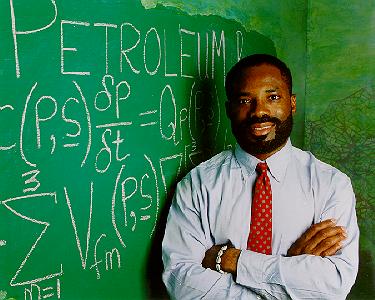


Click on emeagwali.com for more information.